

VLT, TSER, SHGC and IR Rejection: How to Read Architectural Window Film Specification
Learn what VLT, TSER, SHGC and IR rejection mean in architectural window films and how to compare specifications for the right performance.
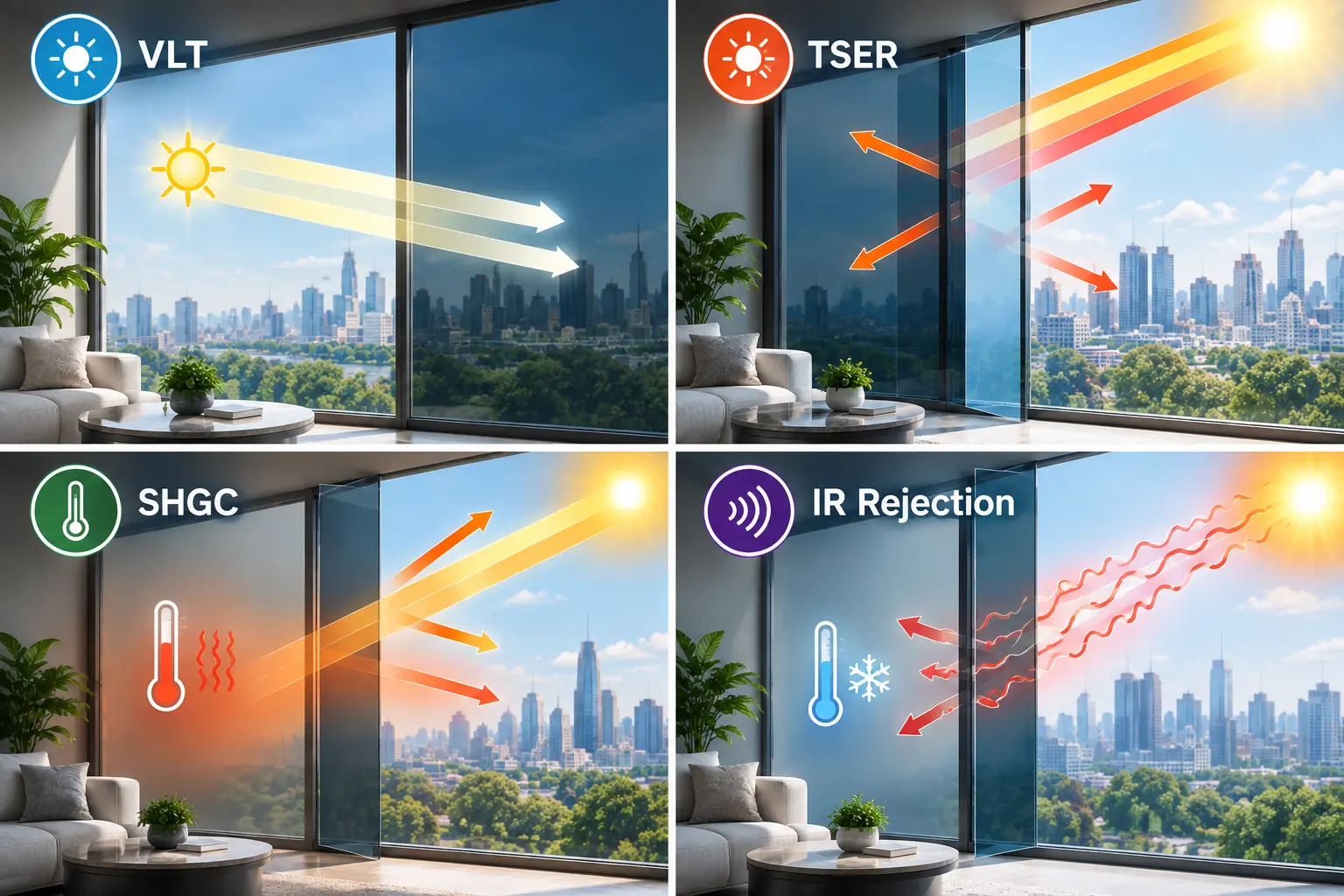
Architectural window film specifications can look technical, but they help buyers understand heat control, daylight, glare, and comfort. VLT, TSER, SHGC, and IR rejection relate to visible light and solar energy in different ways. On a commercial façade, these figures can affect glass performance, cooling demand, glare, and occupant comfort.
A high number isn't automatically better. High IR rejection, for example, does not necessarily mean the film offers the strongest overall heat control. The most useful approach is to read VLT, TSER, and SHGC together, then use IR rejection as supporting information.
Here is how each specification fits into the bigger picture.
What Is VLT in Window Film?
VLT in window film means Visible Light Transmission. It indicates how much visible light passes through the glass and film. A higher VLT generally creates brighter interiors and preserves more daylight transmission, while a lower VLT can create a darker appearance and contribute to glare reduction.
VLT does not directly measure heat rejection. A film with relatively high VLT can still provide substantial solar control, depending on its construction. For commercial window film projects, VLT should therefore be considered alongside privacy, glare, interior brightness, and the desired appearance of the façade.
What Is TSER in Window Film?
TSER in window film means Total Solar Energy Rejected. It shows the amount of solar energy the glazing system keeps out, including visible, infrared, and ultraviolet energy.
A higher TSER generally means better overall solar control, making it an important figure in solar control window film specifications. In areas with strong sunlight, it can give a better indication of heat-control performance than infrared rejection alone.
What Is SHGC in Window Film?
SHGC in window film means the Solar Heat Gain Coefficient. SHGC indicates how much solar heat enters a building through the glazing system. A lower SHGC means less solar heat gain and can support a lower cooling load.
This makes SHGC particularly relevant for energy modelling and façade performance assessments. The value should be checked for the actual film-and-glass combination rather than treated as a universal property of the film itself. For energy-focused projects, SHGC in window film deserves close attention.
What Is IR Rejection in Window Film?
IR rejection in window film refers to the film's ability to reject infrared radiation. Infrared energy contributes to the heat associated with sun-exposed glazing, so strong infrared performance can help improve occupant comfort near windows.
IR rejection is not always measured across the full infrared range. The reported figure may apply to specific wavelengths or test conditions, so it should not be taken as a measure of total heat rejection. TSER vs IR rejection is simple: TSER covers all solar energy, while IR rejection covers the infrared part.
VLT vs TSER vs SHGC vs IR Rejection: What Do They Mean?
These four figures answer different questions, so they should not be treated as interchangeable. The comparison below provides a practical way to interpret VLT vs TSER vs SHGC vs IR Rejection.
| Specification | What It Shows | Higher Value Means | Best Used For | Key Caution |
|---|---|---|---|---|
| VLT | Visible light passing through glass and film | Brighter interiors | Daylight, visibility, glare balance | High VLT does not always mean high heat rejection |
| TSER | Total solar energy rejected | Better overall solar heat control | Heat rejection and comfort comparison | Should be read with VLT and SHGC |
| SHGC | Solar heat entering the building | More heat enters the space | Cooling load and energy analysis | Lower SHGC is better for heat control |
| IR Rejection | Infrared radiation rejected | Better heat comfort near glass | Understanding infrared performance | May be measured at selected wavelengths |
The key takeaway is that the specifications are related but different.
How to Read an Architectural Window Film Spec Sheet
A window film spec sheet should be read against the actual objective of the project rather than as a list of impressive percentages. Start by identifying whether heat control, glare, daylight, privacy, UV protection, appearance, or energy performance is the priority.
Then review the key window film performance ratings- VLT, TSER, SHGC, and IR rejection- together. Check whether the stated values apply to the film itself, the film-and-glass combination, or another glazing configuration. Test conditions also matter, so comparisons should use consistent measurement methods.
Check visible reflectance if façade appearance matters. Before choosing a film, review the full product data sheet and make sure it meets the building’s commercial window film specifications.
How to Choose Window Film Based on Building Performance Goals
The right film depends on what the building needs from its glazing. Use the specifications below to narrow down the most suitable option.
- Heat control: Prioritize high TSER and low SHGC.
- Daylight: Look for a balanced VLT without sacrificing solar control.
- Glare: Consider VLT alongside the expected glare reduction.
- Privacy: Review VLT and visible reflectance.
- Interior protection: Check UV rejection.
- Energy performance: Focus on SHGC and potential cooling-load impact.
- Premium façades: Balance solar performance with reflectance and appearance.
Climate, glass type, window orientation, shading, and existing glazing also matter. This is where companies like Global Hi-Tech Films bring performance and practicality together, with architectural window film solutions designed to balance solar control, comfort, daylight, and façade appearance.
Common Mistakes When Comparing Window Film Specifications
A few common mistakes can lead to the wrong choice. Choosing a film only for its darker look may rule out high-VLT options with good solar control. High IR rejection alone also does not make a film the best heat-rejection window film.
Other common errors include ignoring TSER and SHGC, comparing figures measured under different conditions, overlooking the existing glass type and façade orientation, and skipping the spec sheet altogether. Manufacturer compatibility guidance should remain part of the selection process.
Choosing Window Film for Solar and Energy Performance
VLT, TSER, SHGC, and IR rejection measure different aspects of window-film performance. VLT relates to daylight and glare, TSER to total solar energy rejection, SHGC to solar heat gain, and IR rejection to infrared energy.
B2B buyers should look at these specifications as a complete set, not rely on one rating alone. The right architectural window film is chosen by matching the full specification set to the building’s needs, not simply the darkest film or the highest IR number.
Read also
 Global Hi-Tech FilmsWindow Films
Does Automotive Window Film Affect GPS, Mobile Signals or Keyless Entry?
Does automotive window film affect GPS, mobile signals or keyless entry? Learn how film construction can influence vehicle connectivity and signals. Explore now.
 Global Hi-Tech FilmsArchitecture
Can Window Film Be Applied to Double-Pane and Low-E Glass?
Can window film be used on double-pane and Low-E glass? Learn about compatibility, glass types, thermal stress and key installation factors. Explore now.
 Global Hi-Tech FilmsWindow Films
Why Does Automotive Window Film Bubble, Peel or Change Color?
Discover why automotive window film bubbles, peels or changes color, the common causes of film failure, and how quality installation helps prevent damage.